





Let’s explore how aluminium helps energy travel the distance
22nd September 2026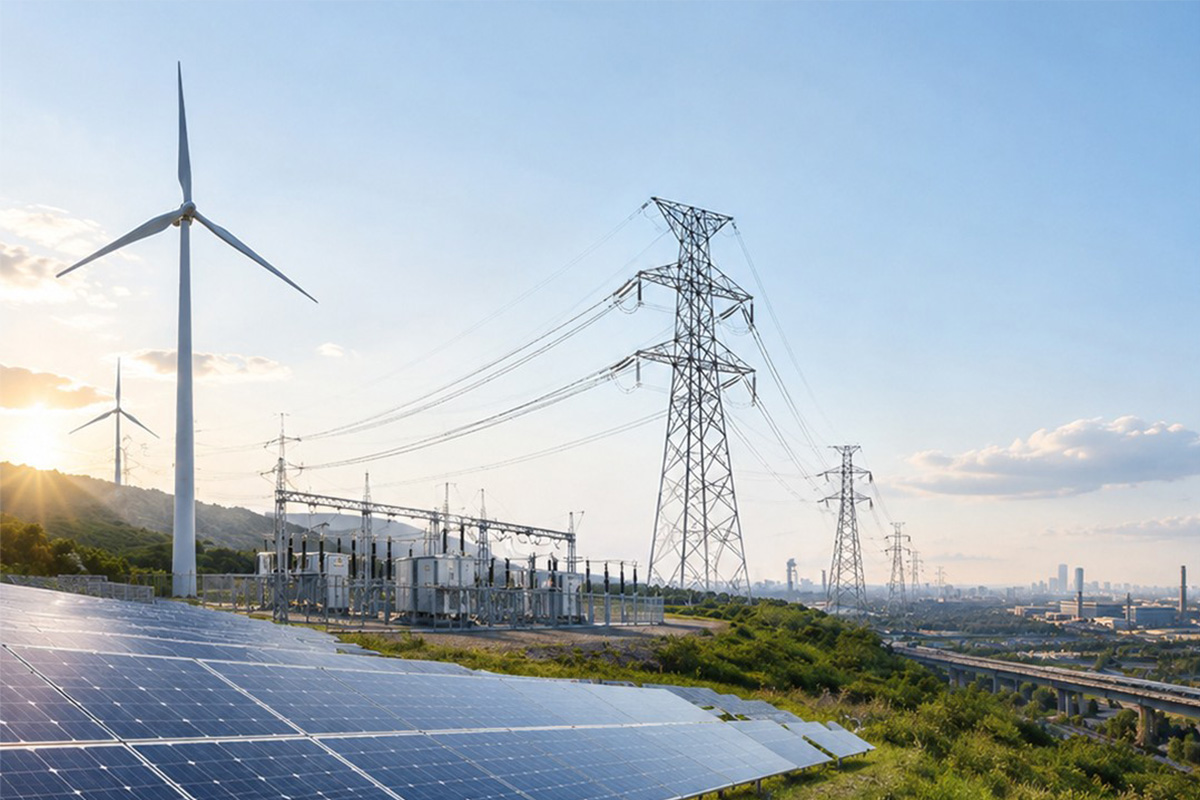
Balconagar 22 Sept. 2026: The future of energy is already taking shape around us. From conventional power generation to solar panels, wind turbines and the transmission networks that connect them, India’s evolving energy landscape is moving the country closer to a more energy-secure future. But this rise in energy production is being met by a rather aggressive expansion in digital infrastructures like data centres, which has multiplied the demand for reliable energy.
Generating energy is only the beginning, the real deal is what moves it ahead.
For energy to reach across homes, industries, railways, metros, aircraft, or business, it requires an infrastructure that is capable of carrying it. This is the spot Aluminium fills in efficiently, and like no other. Aluminium is used across several components of these systems, including solar module frames, mounting structures, power grids and wind energy components. Its versatility of being lightweight, corrosion-resistant, a good conductor and recyclable makes it well suited to energy infrastructure operating across varied environments.
Let’s move to the next chapter and take a look at what moves Power.
Many of India’s renewable energy projects are located far from the cities, industries and businesses that consume the electricity they generate. This makes transmission networks an important part of the energy transition. Before reaching our homes or factories, electricity must be carried from its source to distribution centres across vast distances. Here, aluminium plays a critical role by enabling efficient and reliable power transmission.
Aluminium-based conductors are widely used in overhead transmission networks because they offer a strong balance of conductivity and weight. But doesn’t copper also do exactly the same? Well, not exactly. Aluminium offers around 61% of copper’s conductivity by volume, while weighing significantly less and costing lesser. This gives aluminium its advantage because for a country with vast and varied geographies, it matters. It puts less stress on transmission towers, helps lower installation costs and supports expansion of power networks across urban as well as remote regions.
Aluminium and its role in India’s energy ecosystem
India’s energy ecosystem is connected and evolving and aluminium finds its application across LNG facilities, offshore platforms, storage systems and pipelines, renewable energy and electrical infrastructure. Since it is also recyclable, it adds another important dimension. Aluminium can be recycled and reused, supporting the circularity ambitions that are becoming increasingly important to India’s sustainability journey.
India’s energy journey with Aluminium is only moving ahead
India’s energy demand is expected to grow 6.3% annually through 2027, according to the International Energy Agency (IEA), driven by industrialisation, urbanisation and increasing electrification. At the same time, India is among the world’s largest clean-energy markets, with 50% of its installed electricity capacity already coming from non-fossil fuel sources, achieved ahead of its 2030 target. The country is targeting 500 GW of non-fossil fuel capacity by 2030 and net-zero emissions by 2070. Meeting these ambitions will require extensive development across renewable energy, transmission networks, energy storage and emerging ecosystems such as green hydrogen.
As one of India’s pioneer aluminium producers, BALCO is rigorously invested in supporting India’s vision and endeavours. To support the nation’s expanding energy ecosystem, BALCO is incorporating variety in its portfolio through billets, wire rods, ingots, rolled products and more. These products find applications across power transmission and distribution networks, electrical infrastructure, renewable energy systems and broader energy infrastructure projects.
BALCO is also one of the largest players in India’s domestic aluminium wire rods segment, with an approximately 33% market share. With a production capacity of 575 KTPA and plans to scale towards 1 MTPA, the company is building capabilities alongside India’s growing energy and infrastructure needs.
From capturing sunlight and harnessing wind, to carrying electricity across distances, aluminium is literally steering India’s energy future forward..

